
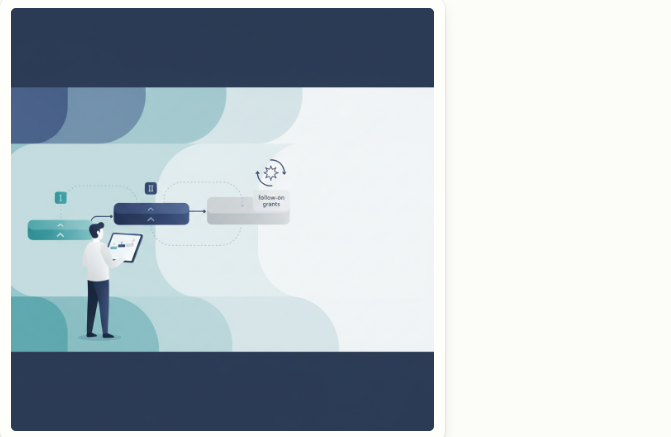
Key Takeaways
- Strategic SBIR sequencing can extend your runway several years beyond one‑off grants while preserving equity and advancing core technical milestones.
- Most small businesses stall at Phase I because they treat SBIR as isolated awards instead of designing a multi‑year, multi‑agency funding roadmap.
- A strong SBIR funding map aligns your technology and commercialization timelines with agency priorities, creating multiple parallel pathways rather than single points of failure.
- Successful SBIR portfolios bridge Phase I technical validation to Phase II market readiness with a clear commercialization strategy that resonates with reviewers and investors.
- Early investment in agency relationships, compliance systems, and internal ownership makes it feasible to manage multiple awards without drowning in administrative risk.
Article at a Glance
SBIR is one of the most powerful non‑dilutive funding engines available to innovative small businesses, but only a minority use it as more than a one‑time grant. The teams that build durable federal funding portfolios approach SBIR as a system, not a series of disconnected opportunities. They deliberately sequence Phase I, Phase II, and follow‑on funding to support a coherent technology and commercialization roadmap.
This article walks through how to design that kind of SBIR funding map. It explains why random grant‑chasing quietly destroys runway, why Phase I should be engineered for Phase II from day one, and how to think about cross‑agency diversification versus deep expertise with a core sponsor. It also covers the governance, compliance, and documentation systems you need to manage overlapping awards without creating audit or reputational risk.
Along the way, you will see a practical sequencing framework and three scenarios showing how different types of companies can use SBIR as a backbone for growth. The goal is not to win “more grants” for their own sake, but to turn federal funding into a predictable, well‑governed component of your broader capital strategy.
Why SBIR Sequencing Makes or Breaks Growth
When entrepreneurs first encounter SBIR, they usually start by chasing individual solicitations that match their current technology. That reactive pattern feels productive in the short term but misses the larger opportunity: building a multi‑year, multi‑agency roadmap that extends runway, compounds credibility, and accelerates commercialization without additional dilution.
The hidden cost of random grant‑chasing shows up in three places:
- Funding gaps: Awards do not line up cleanly, creating dead zones between projects that force layoffs, emergency bridge rounds, or expensive debt.
- Fragmented focus: Teams bounce between unrelated projects to fit available topics, instead of concentrating on a single coherent market solution.
- Lost compounding: You never fully leverage past performance, reviewer familiarity, or agency relationships, so each proposal behaves like a cold start.
Companies that treat SBIR as one‑off transactions often see weak conversion from Phase I to Phase II and end up trapped in a cycle of perpetual proposal writing with limited commercial progress. Over time, that pattern burns out teams and erodes credibility with agencies and investors who are looking for disciplined, system‑level execution.
A strategically sequenced portfolio looks very different. Instead of one Phase I followed by a single Phase II and a cliff, you see staggered submissions across agencies and topics that support the same core technology. Done well, this can translate into several years of continuous non‑dilutive funding, with overlapping projects that each move a different part of the technical and commercial story forward.
Investors have noticed. Many now view a coherent federal funding strategy as a signal of capital efficiency, not a distraction. A clear SBIR roadmap that shows how grants will systematically retire technical risk and unlock key milestones tells investors you can achieve more with less equity and are thinking like a portfolio manager, not a grant hobbyist.
The System Behind SBIR Success and Failure
SBIR is not just “free money.” It is a structured ecosystem with its own rules, rhythms, and internal politics. Leaders who understand those dynamics can design repeatable funding sequences; those who do not typically bounce from one unpredictable outcome to the next.
Three system‑level mistakes cause most long‑term SBIR failures:
- Treating Phase I as an endpoint.
Phase I is supposed to de‑risk Phase II. If your Phase I work does not produce compelling technical evidence, user feedback, and a sharper commercialization narrative, you have reduced your chances of progression. Viewing Phase I as the goal instead of a step almost guarantees that your portfolio will stall. - Ignoring agency‑specific reality.
NIH, DoD, NSF, DOE, and other agencies all fund innovation, but they care about different missions, evaluation criteria, and success stories. Cloning one proposal across agencies without tailoring missions, language, and outcomes wastes scarce cycles. Teams that invest time to understand each agency’s real priorities and reviewer expectations see higher win rates with fewer submissions. - Underestimating compliance until it is too late.
A single Phase I can be managed on spreadsheets. Multiple Phase II awards across agencies cannot. Timekeeping, cost allocation, subrecipient oversight, and reporting requirements escalate quickly. Teams that postpone building basic compliance infrastructure find themselves fighting audit risk, cash‑flow issues, and administrative chaos right when they should be scaling.
Behind these issues is a more fundamental problem: no one owns the SBIR system inside the company. Without clear leadership, SBIR becomes a series of tactical decisions rather than an integrated component of the capital and product strategy.
What a High‑Performing SBIR Funding Map Looks Like
A mature SBIR funding map looks less like a linear Gantt chart and more like a board: a set of interlocking paths that connect your technology roadmap, commercialization strategy, and agency landscape.
At minimum, a high‑performing map makes four things visible:
- Technical milestones: Where you are today (TRL, prototypes, data) and which questions you must answer over the next 24–36 months to be commercially credible.
- Commercial milestones: Regulatory steps, pilots, early customers, and partnerships that prove real‑world fit and purchasing intent.
- Agency pathways: Which agencies and topics align with each milestone, and how Phase I and Phase II opportunities from different sponsors can be sequenced or run in parallel.
- Capital mix: Where SBIR and STTR dollars fit relative to equity, debt, and revenue, with clear assumptions about timing and dependencies.
A useful way to visualize this is the Technology–Commercialization Bridge Model. Instead of thinking “Phase I equals science, Phase II equals product,” you explicitly connect each technical milestone to a commercialization action.
For example:
- A device company aligns Phase I experiments with data needed for a specific regulatory pathway, so the work supports both the grant and the eventual submission package.
- Their Phase II focuses on clinical validation and operational integration in pilot sites, structured so results satisfy agency success criteria and give investors and strategic partners the evidence they want to see.
Another key design choice is whether to go deep with one agency or diversify across several.
| Strategy | When It Fits | Advantages | Risks and Requirements |
| Deep focus on a single agency | Core tech strongly aligned with one mission | Strong relationships, higher win rates, simpler ops | Vulnerable to policy shifts, budget changes |
| Cross‑agency diversification | Platform tech with multiple use cases | More stable funding, broader market validation | Higher complexity, heavier compliance requirements |
Most successful teams start with depth: they establish credibility and learn the culture of one primary agency. Once they have a track record and internal systems in place, they intentionally expand to complementary agencies to open new application domains and reduce concentration risk.
Finally, high‑performing SBIR portfolios share one operational trait: clear internal ownership. Someone is responsible for:
- Portfolio design and sequencing decisions.
- Proposal strategy and quality.
- Relationship management with program staff and contracting teams.
- Compliance oversight and audit readiness.
- Integration of SBIR work into the broader product and market roadmap.
Without that connective role, projects drift, deadlines slip, and the organization never fully leverages what it has already earned.
A Practical SBIR Sequencing Framework for Leaders
To move from concept to execution, leadership needs more than exhortations; they need a simple framework that can be used in planning sessions and board conversations. The SBIR Funding Map Model gives you that structure.
The SBIR Funding Map Model
The model has four interconnected steps:
- Clarify technology and commercialization horizons.
- Design your Phase I and Phase II arc.
- Layer follow‑on and parallel funding.
- Build a time‑ and compliance‑aware application calendar.
Each step forces explicit decisions about what you are building, how quickly you need to get there, and which federal funding routes realistically support that journey.
Step One: Clarify Technology and Commercialization Horizons
Begin with a 24–36‑month view of where your technology and business need to be. This includes:
- Current TRL and critical technical milestones (e.g., prototype completion, performance benchmarks, integration with key platforms).
- Commercial milestones (e.g., first paying customers, regulatory submissions, pilot completions, key partnerships).
Write these down in plain language. Then ask: “Which of these steps are inherently risky, expensive, or hard to fund from revenue or equity?” Those are your primary candidates for SBIR support.
In parallel, capture the commercialization story that must evolve over time. Phase I may only require a plausible market and a credible path to customers. By Phase II, reviewers and investors expect concrete evidence: letters of support, pilot commitments, early adoption metrics, and a sharper understanding of pricing and channel strategy.
Step Two: Design Your Phase I and Phase II Arc
With your horizons defined, design how Phase I and Phase II will work together rather than as separate events.
For Phase I:
- Select topics that are technically meaningful and clearly connect to a larger program of work.
- Design experiments and deliverables that create the data, prototypes, and customer insights reviewers will expect to see in a Phase II application.
- Plan early commercialization actions (e.g., interviews, pilot scoping, regulatory consults) and bake them into the work plan.
For Phase II:
- Define how the award will move you from promising prototype to a product that is credible in real‑world settings.
- Clarify what “success” looks like in terms of deployment, user acceptance, and readiness for follow‑on contracts or commercial sales.
- Identify agency‑specific Phase II extensions or supplements that could be relevant if you demonstrate traction.
The goal is simple: by the time a reviewer reads your Phase II proposal, Phase I should make your progression feel obvious, not aspirational.
Step Three: Layer Follow‑On and Parallel Funding
Next, decide where follow‑on and parallel funding can amplify the core sequence.
Options include:
- Phase II enhancements or IIB‑style supplements for projects with strong early commercial signals.
- Additional SBIR or STTR Phase I awards for different use cases or customer segments built on the same core platform.
- Non‑SBIR grants, demonstration projects, or pilot programs that fund integration and deployment.
- Strategic or venture investment timed to coincide with major evidence milestones, so you negotiate from a position of strength.
Here, clarity about scope is non‑negotiable. Each award must have distinct objectives, deliverables, and budgets, even if they share underlying technology. That is how you avoid double‑charging and scope confusion when agencies review your portfolio.
Step Four: Build a Time‑ and Compliance‑Aware Application Calendar
Finally, put it all on a calendar that respects three realities:
- Agency rhythms: When solicitations drop, review timelines, typical award start dates, and historical hiccups.
- Cash‑flow needs: When each award must land to avoid gaps and when you might need bridge capital.
- Operational capacity: How many serious proposals and active projects your team can handle without compromising quality or compliance.
This calendar should include internal milestones such as:
- Go or no‑go dates for upcoming solicitations.
- Internal deadlines for draft completion and reviews.
- Planned check‑ins with program officers or TPOCs.
- Compliance checkpoints to ensure systems keep pace as volume grows.
You now have a living SBIR operating plan, not just a wish list.
Phase‑by‑Phase Leadership Decisions and Trade‑offs
Even with a structured framework, leaders still face a set of recurring decisions at each phase. Treat these as board‑level topics, not back‑office details.
Phase I Strategy as a Launch Platform
In Phase I, the temptation is to “just get funded.” The stronger move is to design Phase I to make Phase II as close to inevitable as possible.
Leadership decisions include:
- How much technical risk to take on versus how much to keep for future phases.
- Which customer or application segment to emphasize first, knowing it will anchor later work.
- How much commercialization activity to include without diluting the technical story.
You also need a plan for relationship building. That means deliberate engagement with program staff, meaningful questions before you submit, and thoughtful follow‑up whether you win or lose. These actions build familiarity and trust that you can draw on in later phases.
Phase II Strategy as a Development and Market Bridge
Phase II is where you either build a product and market story that agencies and investors can believe in, or you burn through a large award without changing your risk profile.
Key trade‑offs:
- How aggressively to push toward deployment versus additional technical refinement.
- How much to invest in pilots, integration, and user training relative to core R&D.
- Where to seek Phase II extensions or supplements, and what commercial signals you will need to justify them.
Phase II is also the stage where investors are watching most closely. They are looking for evidence that SBIR dollars are moving you toward durable revenue, not just more R&D.
Beyond Phase II: Building Durable Revenue Streams
Once multiple Phase IIs are underway or completed, the question shifts from “how do we win the next grant” to “how do we convert federal validation into sustainable revenue?”
Options include:
- Targeted Phase III‑style contracts or other procurement vehicles that purchase your solution rather than fund more research.
- Additional non‑SBIR programs within the same agencies that focus on deployment and scale.
- Strategic partnerships that use SBIR‑generated IP and data as the foundation for joint offerings.
At this stage, federal funding should be one pillar of a broader go‑to‑market strategy, not your only lifeline.
Governance, Compliance, and Risk Management Across Awards
You cannot scale SBIR funding safely without real governance. The mechanics are not glamorous, but they are what separate sustainable portfolios from cautionary tales.
Building an Internal SBIR Operating System
A simple SBIR operating system typically includes:
- Centralized opportunity tracking: One place where all solicitations, deadlines, and status updates live.
- Standardized proposal processes: Templates, review checklists, and clear roles for technical, financial, and commercialization input.
- Financial controls: Award‑specific budgets, time and expense tracking, and clear rules for allocations.
- Compliance oversight: Routine reviews of allowability, documentation quality, and contract terms.
- Agency relationship routines: Planned touchpoints with program officers and contracting officers, not just last‑minute outreach.
This does not require a large team. It does require explicit design and leadership attention so that compliance is built into operations rather than bolted on in a panic.
Managing Overlapping Awards and Multi‑Agency Portfolios
As your portfolio grows, overlapping awards become both a blessing and a risk. The operational challenge is to use the same underlying platform across projects without blurring lines that matter to auditors and contracting officers.
Leaders should insist on:
- Clear written scopes for each award, with non‑overlapping deliverables.
- Regular internal reviews to confirm that staff, equipment, and expenses are being charged correctly.
- A simple decision framework to decide whether to accept new awards based on capacity, strategic fit, and compliance risk.
The moment you sense that governance is lagging behind award volume is the moment to slow new applications until your system catches up.
Documentation Practices That Prevent Audit Disasters
Good documentation is not busywork; it is insurance.
Best practices include:
- Contemporaneous notes on technical decisions and changes in project direction.
- Periodic milestone verification, with short internal summaries that can be reused in reports and future proposals.
- Organized archives of deliverables, correspondence, and approvals by award.
This makes it much easier to respond to agency questions, defend spending decisions, and demonstrate past performance when pursuing the next opportunity.
IP Protection Across Your SBIR Portfolio
Data rights and IP treatment vary by agency and sometimes by program. As you layer awards, you need a coherent view of:
- Which data is protected for a period and under what terms.
- How inventions will be disclosed and who owns what, especially in STTR collaborations.
- How your patent and trade secret strategy aligns with expected future contracts or licensing deals.
Treat IP strategy as part of your funding map, not a separate legal exercise.
Scenarios: How Different Companies Might Use SBIR Sequencing
The right SBIR strategy depends on your business model, technology, and capital plan. Three brief scenarios illustrate how the same principles play out in different contexts.
Scenario One: Deep‑Tech Hardware Startup with Long R&D Cycles
A materials science startup is developing advanced composites for aerospace and energy. Their development timeline spans several years and requires expensive testing infrastructure.
Their SBIR sequence might look like:
- Initial Phase I with NSF to establish fundamental performance characteristics.
- Parallel Phase I awards with DOE and DoD to explore energy storage and defense applications of the same material.
- Follow‑on Phase II awards focused on rigorous testing and prototyping for each domain.
- Later‑stage supplements or pilot programs to support integration with partner systems.
By year three or four, the company may be managing multiple Phase II awards, each addressing a different market while still strengthening a single core technology platform. The trade‑off is higher operational complexity in exchange for significant non‑dilutive runway and multi‑sector validation.
Scenario Two: Software and Data Company Working Across Agencies
A software company builds an AI‑driven analytics platform. They anchor their early SBIR work with a health‑focused Phase I, establishing algorithm performance in a clinical setting. As they progress to Phase II and show early adoption, they pursue additional Phase I opportunities with security and defense agencies using the same underlying platform.
Over several years, the company:
- Deepens its healthcare presence through NIH‑backed validation and deployment.
- Uses security‑oriented awards to harden the platform, improve performance at scale, and open new revenue channels.
- Eventually transitions from SBIR to direct contracts and enterprise agreements with agencies and large integrators.
Here, cross‑agency diversification builds resilience and broad optionality, but demands rigorous scope management and documentation to keep awards cleanly separated.
Scenario Three: Established Small Business Adding a New Innovation Line
A contract manufacturer already serving federal customers wants to develop an innovative production process. They use SBIR to de‑risk the R&D while continuing to operate their core business.
Their approach:
- Focus on a single agency aligned with existing relationships.
- Sequence one Phase I and one or two Phase II awards that steadily move the new process from concept to shop‑floor reality.
- Use existing cash flow to cover gaps and match requirements, treating SBIR as an accelerator rather than lifeline.
This strategy favors depth and simplicity. SBIR becomes a tool to modernize capabilities and protect competitiveness without diverting management attention from current revenue streams.
Leader‑Level Frequently Asked Questions
How many SBIR projects can one small business realistically manage at once?
Most teams can manage a handful of active awards if they have a basic operating system in place and clear ownership. The real limit tends to be compliance and management bandwidth, not technical ability. Once the portfolio grows beyond that range, you either strengthen governance or accept rising risk.
What happens if we do not win Phase II after completing Phase I?
A Phase I without Phase II is not a total loss. You still have data, prototypes, and early market insights. The key is to plan for this possibility in your funding map by identifying alternative agencies, programs, or capital sources that could pick up where Phase I left off.
Can we pursue SBIRs from multiple agencies at the same time?
Yes, and many companies do. The challenge is to maintain clear scope boundaries and understand the distinct expectations and administrative demands of each sponsor. Many teams build depth with one agency before expanding to others to avoid being overwhelmed.
How should we think about intellectual property rights across SBIR phases?
You generally retain rights to what you develop, but the specifics of data rights, disclosures, and preferred clauses differ. Treat IP and data rights as design inputs when you plan which agencies and programs to pursue, and ensure your internal agreements and documentation keep pace.
Should we rely on external consultants or build in‑house SBIR expertise?
For occasional or early‑stage participation, specialized external support can be efficient. As your volume of submissions and awards grows, internal capability becomes more valuable, especially for maintaining relationships and institutional knowledge. Many successful teams use a hybrid approach: internal leadership plus targeted outside expertise where it matters most.
How do we integrate SBIR funding with private investment without creating conflicts?
Investors will want clarity on how grant‑funded work supports the product and revenue strategy, and on any constraints associated with data rights and IP. The strongest position is to show a plan where SBIR dollars reduce technical and market risk ahead of key equity milestones, rather than replacing private capital entirely.
When should we think about “graduating” from SBIR to other federal contract vehicles?
Once your technology is mature and buyers are more interested in deployment than experimentation, SBIR should shift from center stage to supporting role. At that point, you will likely lean more on other procurement pathways, with SBIR used selectively for next‑generation R&D.
Turning SBIR into a Strategic Growth Engine
When you step back, the core shift is simple: SBIR works best when treated as a governed portfolio, not as a collection of opportunistic bets. That means designing a funding map that aligns with your technology and commercialization horizons, being explicit about trade‑offs at each phase, and investing early in the systems that allow you to scale awards without scaling risk.
A practical next step is to put your current and planned SBIR activity on a single page: technology milestones, commercial goals, agency pathways, and award timing. Pressure‑test that map with your leadership team and board. Look for gaps, overreliance on single sources, and places where compliance and governance are out of step with your ambitions.
If you want a sharper view of what a compliance‑first SBIR portfolio could look like for your company, it can be valuable to get an outside perspective. A focused assessment of your current funding stack, agency relationships, and internal systems can surface blind spots and identify concrete sequencing moves. From there, you can decide where SBIR should sit in your broader capital strategy and how to structure a funding roadmap that supports your growth without putting your business at risk.