
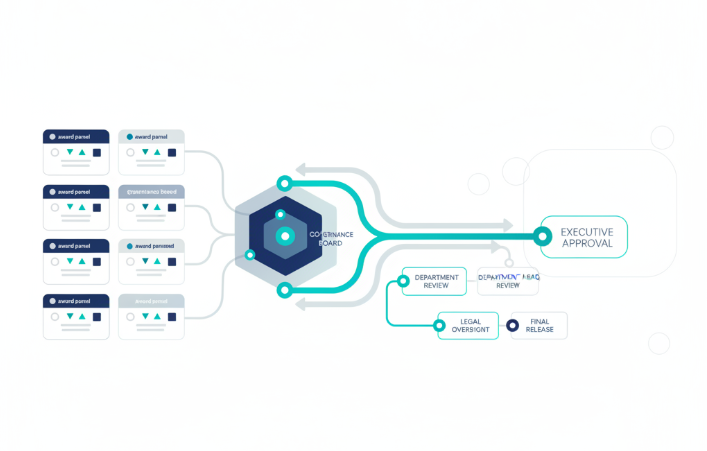
Key Takeaways
- Unclear governance in federal portfolios creates compliance risk that shows up as disallowed costs, delayed payments, and strained agency relationships.
- The strongest governance models align decision rights with both technical expertise and contractual authority, not just organizational hierarchy.
- Multi award environments need formal approval matrices that balance compliance requirements with operational efficiency.
- Governance becomes more critical as your federal portfolio expands across agencies, award types, and business units.
- Risk based routing and clear escalation paths reduce bottlenecks while preserving appropriate oversight.
Article at a Glance
Managing multiple federal awards without a defined governance model is like driving a complex highway system with no signs. The rules exist, but without clear direction, your teams make inconsistent decisions, expose the organization to risk, and frustrate agency partners.
As your federal portfolio grows across agencies and award types, the governance structure that worked for your first grant or contract quickly breaks down. A decision that used to be handled in a hallway conversation now has implications for cost allowability, reporting, audit exposure, and long term agency trust.
Leaders who treat governance as an afterthought end up in permanent firefighting mode: stalled awards, conflicting advice from counsel, unexpected audit findings, and finger pointing when something goes wrong. Leaders who design governance deliberately turn the same complexity into an asset, using decision structures that make it easier to execute, pass audits, and grow confidently.
This article walks through why governance fails in multi award portfolios, who actually holds power in federal decisions, and how to design a practical, risk based governance model that scales with your portfolio.
Why Approval Governance Breaks in Multi Award Portfolios
The Perfect Storm: Multiple Agencies, Multiple Awards
Multi award environments create a governance problem that most commercial businesses never face. Each agency brings its own regulations, norms, and approval sensitivities. An NIH research grant and a DoD services contract can sit side by side in your portfolio while demanding completely different decision paths.
Layer on multiple award instruments and the complexity multiplies. Grants, cooperative agreements, contracts, and other transaction authorities each carry distinct rules about scope changes, budget shifts, key personnel, intellectual property, and reporting. The approval process that feels “about right” for a Phase I SBIR may be dangerously weak for a Phase II award that involves subcontractors, commercialization, and higher dollar value.
Small businesses feel this transition acutely. What started as a founder centric decision model with one award becomes unmanageable as more agencies and mechanisms enter the mix. Without formal governance, individual awards get run one way, portfolio level risk is invisible, and precedents get set accidentally rather than intentionally.
Hidden Costs of Unclear Decision Rights
Unclear governance does not just slow work; it changes the risk profile of your entire federal strategy.
- Program managers hesitate on time sensitive decisions because they do not know who must sign off, leading to missed milestones and strained relationships with agency counterparts.
- Finance teams juggle different interpretations of allowability, documentation, and approval thresholds across awards, increasing the likelihood of questioned costs and disallowances.
- Technical leaders get conflicting direction when they serve more than one federal customer, especially when internal stakeholders interpret agency guidance differently.
- Executives only hear about governance failures when they have already turned into audit findings, payment holds, or threatened recompetes.
The most concerning risk is the set of blind spots that only become visible during an agency review. Decisions that seemed reasonable at the time cannot be defended because the organization lacks a clear record of who approved what, on what basis, and with reference to which requirements.
When Compliance and Efficiency Collide
The heart of the governance problem is a tension between control and speed.
- Overcentralized approval means every decision flows through a narrow set of senior leaders or compliance reviewers. The portfolio moves slowly, teams hoard workarounds, and technical staff see governance as an obstacle.
- Overdistributed approval means nearly anyone can say “yes” within their piece of the portfolio. Local decisions may be fast but inconsistent, setting dangerous precedents and leaving audits to unravel a patchwork of interpretations.
You cannot solve this by defaulting entirely to one side. Governance that works in a multi award environment is explicit about where the organization will accept slower, centralized decisions for the sake of control, and where it will embrace distributed decision making with guardrails so work can move at operational speed.
The Key Decision Makers and Their Real Authority
Effective governance starts with a sober look at who actually has power over federal decisions today, not just who appears on the org chart. Four stakeholder groups matter most inside the organization, plus one group outside it.
Program and Portfolio Leadership
Program managers and portfolio leaders live closest to day to day execution. They see technical progress, subcontractor performance, staffing realities, and agency feedback in real time. In immature governance environments, their authority is either too broad (“PM decides everything”) or too narrow (“PMs can recommend but not decide”).
Mature governance models draw a bright line between decisions program leaders can make independently and those that require escalation. Examples that belong with program leadership include routine task allocations, minor schedule adjustments within the approved scope, and low dollar internal rebalances that do not change budget categories or period of performance.
At the portfolio level, leaders face cross award tradeoffs: shared resources, overlapping deadlines, and conflicting agency expectations. These are governance gray zones in many organizations. A well designed model specifies who can arbitrate these conflicts, which portfolio wide decisions require executive review, and how tradeoffs are documented so they can be explained to auditors and agency partners.
Contracting and Legal Authorities
Binding commitments to the federal government belong with people who hold explicit authority to make them. In practice, this means roles such as Authorized Organizational Representative, contracts manager, or similar titles depending on the institution.
These roles are accountable for representations, certifications, and agreement language, yet they may be several steps removed from the day to day project realities. Governance works when:
- Operational teams know exactly which decisions cross into “binding commitment” territory.
- Contracting and legal stakeholders are brought in at the right time, with the right context, not handed decisions after the fact.
If your approval paths allow program staff to imply commitments that formal authorities have not vetted, you have a structural risk that will eventually emerge under scrutiny.
Technical, Finance, and Executive Stakeholders
Technical leadership (principal investigators, chief engineers, domain experts) carries the knowledge needed to assess feasibility, risk, and quality. In many portfolios, their influence is strong but informal. Decisions about design tradeoffs, milestone criteria, or go and no go gates may happen in technical forums but never appear in the governance map.
Finance stakeholders bring a different lens: allowability, allocation method, indirect rate impact, and the downstream effects of today’s choices on future audits. For them, an approval is not simply “yes or no” but a precedent that will be referenced across awards and years. Governance needs to spell out which financial decisions can be taken at project level (for example, small within category shifts) and which always require senior finance signoff.
Executives remain accountable for the overall portfolio, but if every routine approval hits their desk, they become a bottleneck. Effective models define:
- The thresholds at which executives must be directly involved.
- The reporting and dashboards that give them visibility into risk without forcing them to adjudicate every action item.
Agency Counterparts: The Invisible but Critical Players
Agency stakeholders are not part of your org chart, but they shape your governance reality. Contracting officers, grants management specialists, program officers, technical representatives, and contracting officer representatives all hold specific authorities that may constrain or override your internal decisions.
Sophisticated organizations maintain matrices that show, by agency and award type:
- Which decisions require agency approval before internal signoff.
- Expected response times for common requests.
- Preferred communication channels and documentation formats.
Ignoring these external authorities leads to internal decisions that look neat on paper but break when they hit the federal side of the relationship.
Three Governance Models for Multi Award Federal Portfolios
Most organizations move through a progression of governance models as their federal portfolios mature. Each model has a place; the risk lies in staying with a model that no longer fits your scale and complexity.
Centralized Control Model
In a centralized model, a small group of senior leaders or a central office reviews and approves most significant decisions. This model tends to emerge in three situations:
- Early in a federal journey, when internal expertise is limited and leaders want tight oversight.
- In highly regulated environments where any misstep would be catastrophic.
- After a painful audit, as a reaction to identified weaknesses.
Centralization brings clear benefits. Standards are consistent across awards, documentation looks similar from file to file, and executive leaders can see and shape key decisions. For a modest portfolio or a team new to federal rules, this protects the organization from inadvertent risk taking.
The tradeoff is speed. As the number of awards grows, the same central approvers become overwhelmed. Cycle times stretch, program teams wait for signatures on routine items, and informal workarounds appear. Once teams learn that “the only way to get things done” is to bypass the official path, the value of centralization erodes.
Distributed Authority Model
A distributed model pushes authority out to program teams, technical leads, and local managers within clearly defined boundaries. Here, the expectation is that those closest to the work can and should make most decisions without waiting on a central office.
This model shines in portfolios that:
- Span diverse agencies and technical domains.
- Rely heavily on experienced program and technical staff who understand federal expectations.
- Need to move quickly in response to sponsor feedback or operational realities.
The risk is fragmentation. Different teams may interpret the same rule differently. One program may require three levels of approval for a scope change while another treats a similar change as minor. During an audit or portfolio review, these variations can look like inconsistency or lack of control, even if each decision made sense in context.
Distributed models work only when there is a strong backbone of training, shared templates, and reference standards that keep local decisions inside an agreed perimeter.
Hybrid and Tiered Governance Model
Most mature federal portfolios converge on a hybrid model. In a hybrid structure, governance is tiered:
- Routine, low impact decisions are delegated to project level.
- Medium risk decisions follow a defined path through functional leads.
- High impact decisions (financial, contractual, reputational) require centralized or executive review.
Tiers can be defined by dollar thresholds, risk ratings, precedent setting potential, or a combination. The point is not to invent complex math, but to be explicit:
- “Below this threshold, the PM and finance lead can decide.”
- “At this level, contracting and legal must be involved.”
- “Above this level, executive review is mandatory.”
Hybrid models balance speed and control yet are harder to implement well. The pitfalls are unclear thresholds, inconsistent use of the tiers, and governance charts that live in SharePoint but not in practice. You avoid these by pairing the design with training, technology, and periodic review.
Common Pitfalls Across Models
Across all three models, certain failure patterns recur:
| Model type | Typical strengths | Common failure modes |
| Centralized | Consistency, visibility, tight control | Bottlenecks, slow cycle times, informal workarounds |
| Distributed | Speed, local responsiveness | Inconsistent standards, uneven documentation, audit vulnerability |
| Hybrid tiered | Balance of speed and control | Confusion about thresholds, inconsistent use of tiers, unclear routing |
Recognizing which pattern you are living with today is the first step toward redesign.
Designing an Approval Matrix That Actually Works
The governance model is the philosophy. The approval matrix is the playbook your teams use every day.
Decision Categories and Thresholds
Start by categorizing decisions that recur across your awards. Common categories include:
- Financial and budgeting decisions: reallocation between budget lines, indirect rate treatment, cost share commitments.
- Scope and technical decisions: changes to deliverables, milestone criteria, methods, or key technical assumptions.
- Personnel decisions: key personnel changes, labor mix shifts, use of consultants and subcontractors.
- Subcontracting and procurement decisions: vendor selection, contract modifications, flow down of requirements.
- Reporting and communication decisions: responses to agency information requests, corrective action plans, formal notifications.
For each category, define discrete decision types and then attach thresholds. A simple example:
- “Budget shift within a single cost category under a modest dollar amount” versus
- “Reallocation across major budget categories” versus
- “Rebudgeting that triggers prior approval under sponsor rules.”
The matrix should spell out, for each decision type and threshold:
- Who initiates.
- Who must review.
- Who must approve.
Risk Based Routing and Documentation Standards
Not all decisions deserve the same amount of process. A risk based approach routes high risk, high visibility, or precedent setting decisions through more robust paths, while allowing routine items to move quickly.
Practical risk drivers include:
- Dollar impact relative to the award and the portfolio.
- Regulatory sensitivity of the area (for example, human subjects, export control, cybersecurity).
- Novelty (first time you are doing this versus following an established pattern).
- Potential reputational impact with the agency or public.
For each segment, pair approvals with documentation expectations. A simple table can clarify this:
| Decision risk level | Typical examples | Required documentation |
| Low | Small intra category budget shifts, minor timing | Email record, brief note in project file |
| Medium | Cross category budget moves, moderate scope tweaks | Short justification memo, approval record |
| High | Major scope change, key personnel change, IP terms | Formal memo, regulatory citations, full approvals |
By setting documentation standards alongside approvals, you avoid both extremes: over documenting trivial items or under documenting decisions that auditors will scrutinize.
Clear Escalation Pathways
No matrix can anticipate every nuance, especially in multi agency portfolios. Governance needs a clear “what we do when the rules are not obvious” path. That path should answer:
- Who interprets the matrix when there is disagreement.
- How quickly teams can get an interpretation.
- What happens when a decision is both time sensitive and ambiguous.
Some organizations designate a governance lead or small committee as the interpretation authority. Others embed this in the contracts office or compliance function. What matters is that everyone knows where to go and that escalation does not become a black hole.
Operating the Governance System Day to Day
The best governance design fails if it cannot survive busy season, staff turnover, or urgent agency requests. Execution matters as much as structure.
Preventing Bottlenecks and Approval Gridlock
Bottlenecks show up in three ways:
- Approvers with too many decisions queued at once.
- Steps that require serial review where parallel review would be sufficient.
- Approvals held by individuals with limited availability or overlapping roles.
Mitigation tools include:
- Assigning backup approvers with clearly defined scope.
- Redesigning approval chains to allow parallel review where risk is modest.
- Setting expected turnaround times and building automated reminders or escalation triggers.
Some organizations add “circuit breakers” for peak periods, such as end of fiscal year, when the volume of modifications and closeout actions spikes. Temporary delegations or focused approval sessions for multiple related decisions keep the portfolio moving without sacrificing oversight.
Handling Exceptions, Emergencies, and Expedited Decisions
You will face situations where normal approvals are too slow: last minute agency changes, urgent subcontract actions, or emerging compliance issues tied to ongoing work. In those cases, governance should bend, not break.
Exception processes work when they:
- Define what qualifies as an emergency.
- Limit who can authorize an exception.
- Require contemporaneous documentation of what was decided and why.
- Trigger post event review to confirm the exception did not set a dangerous precedent.
Using emergency paths to compensate for chronic delays is a warning sign. If exceptions become routine, the underlying governance design needs attention.
Training Teams on Who Decides What
Approvals are only as good as the people who use them. Governance needs to be part of onboarding and ongoing development for anyone who touches federal awards.
Effective training does not just walk through a matrix; it uses scenarios:
- “You discover you need to reallocate labor across tasks with different sponsors. What do you do, who do you call, and what needs to be documented?”
- “A PI wants to add a new subcontractor midway through the period of performance. What path does that follow?”
Role specific training for program managers, technical leads, finance, and contracts staff helps each group understand both their authority and their obligations. Governance “office hours” or a help desk give teams a channel to ask questions before decisions harden into audit issues.
Special Considerations for SBIR and R and D Intensive Portfolios
Research heavy portfolios face governance complexities that go beyond standard service or supply contracts. Uncertainty is part of the work, but it cannot become an excuse for weak decision structures.
Technical and Phase Gate Decisions
In SBIR, STTR, and other research programs, technical phase gates determine whether projects:
- Continue as planned.
- Pivot to a new approach.
- Wind down and free resources for other priorities.
These decisions need clear ownership and criteria. Governance should specify:
- Who chairs phase gate reviews.
- What evidence and metrics are required.
- How financial and compliance implications are factored alongside technical merit.
The governance structure for a Phase I feasibility study will rightly differ from that for a Phase II development award. As commercialization enters the picture, business, legal, and marketing perspectives become part of the decision set. Your model should evolve across phases rather than applying a single pattern to every stage.
Commercialization, Intellectual Property, and Partnering Decisions
In research awards, governance often breaks around commercialization and IP, where federal rules and business realities intersect. Decisions about:
- Filing or not filing for patent protection.
- Granting licenses or data rights.
- Entering into teaming or joint development arrangements.
All carry compliance implications tied to funding agreements and agency expectations. Clear governance answers:
- Which roles are required to approve IP and commercialization decisions.
- How agency specific rights and obligations are factored into those approvals.
- How these decisions are documented so they can be explained years later.
Pulling technical, legal, and business leads into a structured decision path protects both scientific integrity and commercial opportunity.
Managing the PI Business Leadership Divide
In research driven organizations, principal investigators may reasonably prioritize scientific objectives, while business leadership focuses on financial sustainability and growth. Left unmanaged, this creates tension in every major decision.
Governance cannot eliminate that tension, but it can give it a productive outlet:
- Regular forums where PIs and business leaders review major decisions together.
- Clear documentation standards for decisions that balance technical and business inputs.
- Agreed principles about how conflicting priorities will be resolved.
When PIs understand the financial and compliance context, and executives understand the scientific stakes, decisions improve and agency relationships strengthen.
Technology Enablement for Approval Governance
Strong governance is hard to sustain on spreadsheets and email alone. The right technology turns your approval model into a repeatable system instead of a collection of intentions.
Workflow and Signature Platforms
Workflow tools allow you to codify the approval matrix into routable steps. They handle:
- Role based routing based on decision type, dollar value, or risk rating.
- Parallel versus serial approval logic.
- Automated reminders and escalations when approvals stall.
Electronic signature capabilities layered onto these workflows capture binding approvals with time stamps and role information. For organizations spread across sites and time zones, this becomes essential.
When evaluating tools, focus less on labels and more on whether the platform can:
- Reflect your actual governance tiers and exceptions.
- Integrate with the systems your teams already use for finance, contracts, and document management.
Audit Trails, Dashboards, and Performance Metrics
Audit trails are the backbone of defensible governance. Your technology should automatically record:
- Who approved which decision.
- When they approved it.
- What documentation they reviewed.
Dashboards turn that raw data into management insight. Useful metrics include:
- Average cycle time by decision type and by approver role.
- Volume and pattern of exceptions.
- Number of approvals approaching or breaching agreed service levels.
Leaders can use these metrics to adjust staffing, refine thresholds, and target training where it will have the greatest impact.
Integration with Existing Financial Systems
Approvals that live in one system while execution lives in another invite error. Integration between governance workflows and financial platforms allows you to:
- Ensure that approved budget shifts appear in the accounting system.
- Catch discrepancies between what was authorized and what was actually charged.
- Align approval records with reports submitted to agencies.
This alignment reduces the risk of disallowed costs and builds confidence when you enter audits or portfolio reviews.
Scenarios: How Different Organizations Might Apply These Models
Seeing governance in action is often more useful than reading abstract principles. The following scenarios illustrate how different organizations might apply the approaches described above.
Scenario One: Single Agency, Growing Multi Award Portfolio
A small firm starts with a single SBIR award from one agency. The founder, PI, and a finance manager handle all decisions informally. As the firm secures additional awards and a Phase II, the founder centric model begins to crack. Approvals lag, milestone decisions pile up, and no one can explain the basis for certain budget moves.
The firm adopts a hybrid governance model with:
- Centralized control over financial decisions that affect allowability and precedent.
- Delegated authority to project leads for lower risk technical and operational decisions.
- A simple approval matrix and a quarterly governance review.
Within a year, cycle times on routine decisions drop, audit readiness improves, and the founder spends less time on ad hoc approvals and more on strategy and agency relationships.
Scenario Two: Multi Agency, Multi Location Federal Portfolio
A mid sized organization holds awards from multiple agencies with offices in different states. An attempt to impose one rigid governance process across all awards backfires: teams complain that processes conflict with agency expectations, and agency representatives push back on unfamiliar internal constraints.
The organization moves to a tiered model:
- Enterprise wide standards for high risk decisions such as major scope changes, key personnel changes, or significant rebudgeting.
- Agency specific variants for operational decisions calibrated to each sponsor’s norms.
- A workflow system that routes approvals based on award metadata and risk level.
Agency relationships improve because internal governance now respects external reality, while executives retain a coherent line of sight into portfolio level risk.
Scenario Three: Innovation Heavy SBIR and R and D Portfolio
A research focused organization holds multiple SBIR and related research awards. PIs view governance as bureaucracy, and compliance staff view PIs as unmanaged risk. Decisions about phase transitions, commercialization, and IP are slow and contentious.
Through a cross functional design effort, the organization creates:
- A distinct decision path for technical gates, led by subject matter experts with defined criteria.
- A complementary path for financial, contractual, and compliance decisions, with cross representation from technical teams.
- A workflow platform with tailored paths for “technical milestone decision” versus “financial or contractual decision.”
Tension does not disappear, but it becomes structured and visible. Decisions are made faster, rationales are documented, and both PIs and executives see governance as necessary infrastructure rather than a barrier.
Frequently Asked Questions on Federal Portfolio Governance
How should we decide which approvals stay with contracting versus program leadership?
Use the nature of the commitment as your guide. Decisions that alter obligations to the government, change terms and conditions, or touch representations and certifications belong with contracting or authorized representatives. Decisions about how to deliver within those obligations, where the contract already provides flexibility, should reside with program leadership. Regular coordination between these groups helps prevent operational decisions from drifting into contractual territory without proper oversight.
What level of documentation is actually necessary to withstand a federal audit?
Aim for documentation proportional to risk. Every significant decision should at least show who approved it, when, and what information they had. High risk decisions, especially those related to costs, scope changes, or sensitive compliance areas, should also reference relevant regulations or award terms and include concise reasoning. Overdocumenting routine actions adds noise without much benefit; underdocumenting consequential decisions invites findings.
How should approval rules differ for grants versus contracts within the same portfolio?
Contracts usually impose more explicit change control and deliverable requirements, while grants often focus on broader program goals within a defined budget and period of performance. For contracts, governance should enforce structured change control, including clearly routed approvals for modifications, extensions, and deliverable changes. For grants, governance often focuses more on ensure spending stays allowable, aligned with objectives, and documented. Your model should teach teams these differences and reflect them in the approval matrix.
When is it safe to delegate approval authority, and what controls should be in place?
Delegation makes sense when teams demonstrate consistent judgment and understand the boundaries of their authority. Safe delegation rests on:
- Written limits by decision type and dollar threshold.
- Periodic review of delegated decisions for adherence to rules.
- Clear escalation paths when a decision falls outside familiar territory.
Start with narrower delegation and expand as experience and trust build. Technology that enforces thresholds and logs decisions helps make delegation safer.
How do governance models need to change as portfolios cross fiscal years or agencies?
Cross fiscal year portfolios require governance that addresses timing decisions such as carryover, no cost extensions, and alignment between periods of performance and internal planning cycles. Multi agency portfolios demand a tiered approach: consistent enterprise rules for high risk decisions, and agency specific adaptations where sponsors differ. Both situations benefit from regular portfolio level reviews that look across awards for patterns and emerging risks, not just at individual projects.
What are early warning signs that our approval process is putting awards at risk?
Warning signs include:
- Frequent “urgent” requests to bypass normal approvals.
- Approvals routinely happening after work has already begun.
- Difficulty producing documentation for key decisions.
- Repeated confusion about who must sign off on common actions.
- Agency feedback that suggests misalignment with expectations.
Any of these should prompt a focused review of your governance model and its implementation.
How often should we review and update our governance model?
Governance should evolve as your portfolio changes. A practical cadence is a structured review at least annually, with targeted interim adjustments when you add new agencies, cross new size thresholds, or experience audits that reveal weaknesses. The review should look at both design (does the model still fit the portfolio) and performance (are decisions timely, defensible, and consistent).
Putting Strong Governance to Work
Treating governance as a living system rather than a static policy changes how your organization approaches federal growth. Instead of reacting to each new award with improvised approvals and one off exceptions, you build an operating model where decision rights are clear, documentation is reliable, and audits become confirmation rather than investigation.
If you are ready to pressure test your current approach, start by mapping a few real decisions from the past six months. Trace who was involved, how long approvals took, what documentation exists, and where agency interaction occurred. That map will reveal where governance supports your teams and where it quietly undermines them.
From there, a structured assessment of your federal portfolio governance can help you redesign approval models, risk tiers, and workflows around a compliance first, operationally realistic standard. If you want support building or refining that system, consider engaging our team for a focused review of your current governance, automation stack, and decision flows. Together, we can design a compliance first governance and automation blueprint tailored to your portfolio, agency mix, and growth goals.