
Key Takeaways
- Questioned costs are not minor bookkeeping issues; they can trigger repayments with interest, damage your compliance reputation, and jeopardize future federal revenue.
- The strongest defense is contemporaneous documentation that ties each expense directly to approved award objectives and meets the five core allowability tests.
- Leaders must understand the federal cost principles and translate them into decision rules, not rely on generic commercial practices or ad hoc staff judgment.
- A repeatable response playbook—team assembly, fact‑finding, position paper, and strategic negotiation—often determines whether questioned costs become disallowed costs.
- Strategic decisions about when to fight and when to concede should factor in precedent, relationships, and long‑term portfolio risk—not just the dollar amount in dispute.
- Durable, preventive compliance systems embedded in everyday workflows reduce questioned costs far more effectively than reactive, one‑off fixes after an audit.
- Organizations that treat compliance as a strategic capability, not a defensive chore, convert audit‑grade controls into a competitive advantage in federal funding.
Article at a Glance
The moment your organization accepts its first federal contract or grant, the standards for financial management change. What once passed as acceptable commercial practice can now create questioned costs, disallowances, and reputational risk if it fails to meet federal cost principles and award‑specific rules. For small and mid‑sized businesses, this shift is often underestimated until an audit letter appears and long‑settled transactions are suddenly under a microscope.
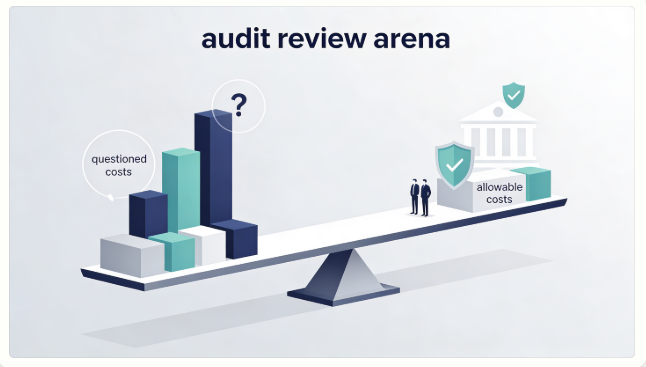
Questioned costs are expenditures that auditors or agency officials believe may not comply with the terms of your award or the governing regulations. They are a signal of potential breakdowns in your financial management and compliance systems—not just a request for more paperwork. Left unmanaged, they can snowball into repayments, special conditions, and even restrictions on your eligibility for future awards.
This guide walks leadership teams through the full lifecycle of questioned costs: how they arise, what they signal about your systems, and how to defend your spending effectively. It covers the federal cost principles at a leadership level, shows what an audit‑ready documentation system looks like, and provides a practical response and decision framework for disputes.
Most importantly, it reframes compliance as a strategic capability. Organizations that build prevention, documentation, and governance into their operating model do more than survive audits—they gain the confidence and track record to scale federal funding without putting the business at risk.
The High Stakes of Questioned Costs for Federal Awardees
What Constitutes a Questioned Cost in Federal Funding
When a federal auditor flags expenses as questioned costs, they are signaling potential non‑compliance with your award terms, applicable regulations, or the underlying federal cost principles. These are not routine accounting queries; they indicate concern that a cost may be:
- Unallowable under federal rules or specific award terms.
- Insufficiently documented to prove it was reasonable and necessary.
- Misallocated or misclassified in a way that obscures its true purpose.
- Incurred outside the approved period of performance or scope.
Common examples include:
- Clearly unallowable items (e.g., entertainment, alcohol) charged to an award.
- Inadequately documented personnel time or effort.
- Indirect‑type expenses (rent, general admin) charged as direct costs without justification.
- Purchases made without following required procurement procedures.
Under the Uniform Guidance and related regulations, the burden of proof lies with your organization. Once a cost is questioned, you must demonstrate that it meets all relevant allowability tests; the agency does not have to prove non‑compliance.
Financial and Reputational Consequences at Stake
The direct financial impact of questioned costs is straightforward: if they are ultimately disallowed, you must repay the federal government from non‑federal funds, potentially with interest. For growth‑stage businesses and lean organizations, unexpected repayments can create serious cash‑flow pressure.
The indirect effects, however, often carry greater long‑term risk:
- Expanded scrutiny of your entire portfolio, not just the award in question.
- More frequent or intensive audits and monitoring that consume leadership and staff time.
- Heightened risk ratings across agencies, leading to special conditions, delayed drawdowns, or more conservative award decisions.
Compliance reputation is a real asset in federal funding. Contracting officers and program officers share information, formally and informally. A pattern of questioned or disallowed costs can follow your organization across agencies, affecting competitiveness and terms of future awards.
The Direct Impact on Future Award Eligibility
Significant questioned costs that remain unresolved—or that reveal deeper systemic weaknesses—can prompt agencies to classify your organization as high risk. This may result in:
- Special award conditions (e.g., reimbursement‑only payments, additional approvals).
- Increased reporting and documentation burdens.
- Reluctance from program officers to recommend you for new or larger awards.
In severe or persistent cases, unresolved questioned costs can contribute to suspension or debarment proceedings. For organizations that rely on federal contracts and grants as a core growth engine, this is an existential risk. Defending your spending effectively is therefore not only a financial management issue but a business continuity concern.
How Questioned Costs Arise: Red Flags and Common Triggers
Questioned costs rarely emerge from a single “bad” transaction. They are more often symptoms of systemic misalignment between your internal practices and federal requirements.
Documentation Gaps That Raise Auditor Eyebrows
Inadequate documentation is the most common reason costs are questioned. Even legitimate expenses will be disallowed if you cannot prove:
- Who incurred the cost.
- What was purchased or performed.
- When and where it occurred.
- Why it was necessary for the award.
- How it advanced the approved scope of work.
Particular problem areas include:
- Time and effort reporting that lacks detail on actual activities.
- Vague descriptions in invoices and purchase orders.
- Missing pre‑approvals where the award or regulations require them.
- Reconstructed records created long after the fact.
For personnel costs, reconstructed timesheets or generic descriptions such as “worked on Project X” are unlikely to satisfy auditors. They want to see contemporaneous records that connect time spent to specific deliverables or objectives.
Misclassified Direct vs. Indirect Costs
Misclassification of direct and indirect costs is another frequent trigger. Federal rules expect:
- Direct costs to be specifically identifiable with a particular award.
- Indirect costs to benefit multiple activities and be allocated through an approved method (often an indirect rate).
Red flags include:
- Charging expenses as direct on an award when your organization usually treats them as indirect (e.g., general administration, facilities).
- Inconsistent treatment of similar costs across different funding sources.
- “Budget‑driven” allocations that follow available funds rather than actual benefit.
Inconsistency suggests that federal awards are being used to absorb more than their fair share of overhead—a pattern auditors are trained to detect.
Unauthorized Budget Modifications and Timing Issues
Budget and timing issues often produce questioned costs:
- Expenditures that exceed approved line‑item budgets without documented prior approval.
- Purchases made at the end of the award period that look like attempts to “spend down” funds.
- Costs incurred before the start date or after the end date without explicit authorization.
While some awards allow a degree of flexibility (e.g., limited rebudgeting between categories), those flexibilities are not universal and often have exceptions (such as equipment or foreign travel). Retroactive requests for approval after money is spent are especially vulnerable to challenge.
Procurement Violations That Trigger Scrutiny
Procurement is another high‑risk area. Federal standards generally expect:
- Appropriate competition above specified dollar thresholds.
- Documented cost/price analysis for larger purchases or sole‑source awards.
- Controls to prevent conflicts of interest—actual or perceived.
Common issues include:
- Sole‑source procurements without adequate justification.
- Weak or missing documentation of competitive bids, quotes, or selection criteria.
- Transactions with related parties without robust evidence of arm’s‑length pricing.
When procurement documentation is thin or inconsistent, auditors may question the entire cost, regardless of whether the goods or services were delivered.
Recognizing Early Warning Signals Before an Audit Letter Arrives
Sophisticated organizations do not wait for a formal audit to discover that costs may be questioned. Early warning signals are usually visible inside your own systems.
Warning Signs in Your Financial and Procurement Systems
Key indicators that you may be accumulating future questioned costs include:
- Significant and unexplained variances between budget and actuals in key cost categories.
- Clusters of high‑value or unusual purchases near the end of the period of performance.
- Frequent “manual workarounds” or off‑system approvals for certain types of transactions.
- Procurement files missing competition documentation, cost/price analysis, or justification for exceptions.
Routine variance analysis and exception reviews—conducted with a compliance lens, not just a financial one—can uncover these issues while there is still time to correct them.
Staff Confusion About Cost Coding and Approvals
Frontline confusion is another early warning:
- Program staff repeatedly asking how to code certain expenses.
- Requests for “exceptions” to standard purchasing or time‑tracking procedures.
- Different departments applying inconsistent interpretations of the same rule.
This usually signals that guidance and training are not keeping up with the complexity of your awards. It is far more efficient to clarify expectations and update your internal guidance than to defend inconsistent practices after the fact.
Monitoring Feedback and Prior Findings
Agencies often signal emerging concerns before they escalate to major findings:
- Requests for additional documentation tied to specific transactions.
- Comments in monitoring reports, desk reviews, or site visits pointing to documentation or control weaknesses.
- “Other matters” or advisory comments in prior audit reports that highlight vulnerabilities, even if no questioned costs were recorded.
Treat this feedback as actionable intelligence. Addressing it proactively strengthens your compliance posture and reduces the likelihood that similar issues will resurface as questioned costs.
Cost Principles 101: The Leadership View of Allowable Spending
Leaders do not need to become technical experts in every regulation, but they do need a clear mental model of what makes a federal cost allowable. The federal cost principles can be distilled into a set of practical tests and decision rules.
The Five Core Tests Every Federal Dollar Must Pass
Most federal awards expect every cost to satisfy five tests:
- Reasonable – A prudent person would pay this amount and structure this transaction under similar circumstances.
- Allocable – The cost can be clearly connected, in proportion, to the award(s) being charged.
- Consistent – Similar costs are treated the same way across the organization and funding sources.
- Conforming – The cost complies with specific limitations or prohibitions in the award or regulations.
- Documented – Adequate records exist to demonstrate all the above.
Leaders can use these tests as a simple decision framework. Before approving major expenditures or policies, ask explicitly whether they pass all five—and whether you can prove it if audited years later.
Reasonableness: What Would a Prudent Person Do?
Reasonableness is not just about dollar amount; it also considers context and necessity:
- Is the product or service necessary to achieve award objectives?
- Is the price in line with market norms for similar items and quality?
- Could a less costly alternative have met the same need?
Documenting market checks, multiple quotes, or internal benchmarking for significant purchases helps demonstrate reasonableness. The more discretionary or atypical the expense appears, the higher the documentation bar.
Allocability: Connecting Expenses to Award Objectives
Allocability focuses on whether and how a cost benefits a specific award:
- Pure direct costs (e.g., materials used only on one project) are relatively straightforward.
- Shared resources (e.g., staff, equipment, facilities) require a rational allocation method based on actual benefit.
Acceptable methods include time‑based or output‑based allocations, provided they are documented and applied consistently. Arbitrary splits or allocations driven by budget gaps are likely to be challenged.
Consistency and Conformance: Policy Alignment and Award‑Specific Rules
Consistency means using the same classification and treatment for similar costs across:
- Federal vs. non‑federal activities.
- Different awards and lines of business.
- Internal policy and actual practice.
Conformance overlays award‑specific requirements and prohibitions. Even if a cost is reasonable and allocable, it may be unallowable because:
- The award bans a category (e.g., certain lobbying or fundraising).
- The agency requires prior approval and it was not obtained.
- The cost exceeds specified caps or per diem limits.
Leaders should ensure there is a clear hierarchy of authority—award terms, agency guidance, internal policy—and that decision‑makers know where to look when rules seem to conflict.
Translating Regulations into Practical Decision Rules
The complexity of federal regulations is daunting, but leaders cannot simply delegate all understanding to finance or legal. The organization needs simple, repeatable decision tools that embed the rules into daily operations.
Critical Questions to Ask Before Approving Expenditures
A short set of questions, applied consistently, can prevent many questioned costs:
- Is this expense in our approved budget, or do we have documented approval for a change?
- How does this cost directly advance specific deliverables in the scope of work?
- Is the timing within the period of performance and consistent with the project plan?
- Have we followed the required procurement procedures for this amount and type of purchase?
- How did we determine the cost is reasonable, and where is that documented?
- Are we treating this cost consistently with how we treat similar costs elsewhere?
Building these questions into approval workflows—rather than relying on individual memory—creates a contemporaneous record that is extremely valuable in a dispute.
Managing Agency‑Specific Rules and Finding Authoritative Guidance
While the Uniform Guidance and the Federal Acquisition Regulation set broad standards, agencies and programs often add their own layers:
- Special terms and conditions attached to your individual award.
- Program regulations or policy manuals.
- Frequently Asked Questions and official guidance memos.
A practical approach is to:
- Maintain a concise “allowability profile” for each major award, summarizing key agency‑ or program‑specific rules.
- Train staff to consult the award first, then agency‑level guidance, then cross‑cutting regulations.
- Document any formal clarifications or approvals received from agency officials, including context and rationale.
When in doubt, seeking pre‑approval or written clarification before incurring a novel or high‑risk cost is usually less expensive than defending it after the fact.
Building an Audit‑Ready Documentation and Evidence System
The best time to build your defense is when you incur the cost, not when an audit begins. An audit‑ready documentation system is designed around how auditors think, not just how your accounting software works.
What “Contemporaneous Documentation” Actually Means
Auditors place special weight on records created at or near the time of the transaction. Examples include:
- Detailed invoices and purchase orders that describe the business purpose.
- Time and effort records completed regularly and tied to specific activities.
- Approval emails or workflow logs captured before or when the cost is incurred.
- Notes or memos explaining unusual decisions or allocation methods.
Recreated documentation—especially if produced only after questions arise—carries less credibility. Processes should be designed so the right level of detail is captured automatically, with minimal extra effort.
Retention Periods and Record Formats
Federal retention rules can easily be misunderstood:
- The standard retention period typically starts from the date of the final financial report, not the date of the transaction.
- Multi‑year awards can therefore require records to be kept significantly longer than three years.
- If there is ongoing litigation, audit, or claim, records must be retained until all matters are resolved.
Electronic systems are acceptable if they preserve integrity, provide audit trails, and allow auditors to trace costs from the general ledger to underlying documents and back. For critical approvals or high‑risk areas, many organizations maintain both electronic and scanned/physical copies as a belt‑and‑suspenders approach.
The “Federal Spending Defense File”
Beyond your normal accounting records, it is useful to maintain a dedicated defense file for each major award. This is a curated set of materials that anticipates common audit challenges.
A typical defense file might include:
- A summary of key award terms related to allowability and approvals.
- Documentation of any prior approvals or special conditions.
- Written analyses justifying unusual or sensitive costs against the core allowability tests.
- A log of budget modifications and the supporting approvals.
- A narrative timeline of major program events or changes that influence interpretation of costs.
- Documentation of verbal guidance from agency officials, memorialized and confirmed in writing where possible.
This file becomes your starting point when costs are questioned, reducing the scramble to assemble a coherent narrative under time pressure.
Responding to Questioned Costs: A Leadership Playbook
Even with strong preventive systems, many organizations will eventually face questioned costs. The quality and tone of your response can significantly influence the outcome.
First 48 Hours: Stabilize, Don’t Scramble
When notified of questioned costs:
- Clarify precisely which transactions and cost categories are at issue.
- Secure a document hold to prevent accidental deletion or destruction of relevant records.
- Conduct an initial internal review to understand the facts and identify gaps.
- Involve legal counsel if the amounts are material or if potential fraud or misconduct is alleged.
- Acknowledge receipt and, if necessary, request a reasonable extension to provide a complete response.
The goal in this phase is to stabilize, gather facts, and avoid premature commitments or statements that might later constrain your position.
Assembling the Right Response Team
An effective response is cross‑functional. It typically includes:
- Finance and accounting for transaction details and system controls.
- Program leadership for context on activities and deliverables.
- Compliance or internal audit for interpretation of rules and prior patterns.
- Legal counsel for risk framing and language, when stakes warrant it.
- Executive sponsorship to align the response with broader relationship and portfolio considerations.
Assign clear roles (fact‑finding, drafting, documentation gathering, regulatory analysis, executive review) and establish a single point of contact for communications with the auditor or agency.
Communication Protocols With Funding Agencies
Throughout the process:
- Keep communications factual, professional, and solution‑oriented.
- Seek clarification where the basis for questioning is unclear, but avoid speculative explanations.
- Confirm key understandings and agreements in writing.
- Maintain a detailed log of all verbal and written interactions, including dates, participants, and substance discussed.
Your objective is to demonstrate cooperation, transparency, and competence, without conceding points you have not fully analyzed.
Crafting Your Written Position and Negotiation Strategy
Your written response is both a legal argument and a narrative about your organization’s stewardship of federal funds.
Structure of an Effective Position Paper
A strong position paper typically includes:
- Executive summary – A concise statement of the questioned costs, your overall position, and the desired resolution.
- Issue‑by‑issue analysis – For each category of questioned costs:
- A brief description of the costs and context.
- The applicable regulations and award terms.
- How your documentation and practices satisfy each relevant requirement.
- Any errors or gaps you acknowledge and how they are being addressed.
- Systems and controls overview – A description of your broader cost‑management and compliance framework, showing that the questioned items are exceptions within a generally sound system (if true).
- Resolution proposal – A clear articulation of whether you seek full allowance, partial allowance, or propose some other remedy.
Attach key supporting documents and provide a roadmap that makes it easy for reviewers to find what they need, without flooding them with unnecessary material.
Supporting Your Case With Regulatory Citations and Evidence
To be persuasive, your response should:
- Cite specific regulatory provisions, agency guidance, or award clauses that support your interpretation.
- Show how your documentation and processes align with those authorities.
- Acknowledge any ambiguities and explain why your interpretation is reasonable and consistent with prior agency communications or practices.
Accuracy matters. Misquoting or selectively citing regulations can damage credibility. Where rules are genuinely unclear, emphasize your good‑faith efforts to comply and any steps you took to seek clarification in advance.
When and How to Request Extensions
If the initial deadline does not allow time for a thorough response:
- Request an extension as early as possible, explaining the volume or complexity of the information needed.
- Provide a realistic timeline and consider committing to interim updates or partial submissions.
- Use the additional time to strengthen your evidence and refine your arguments—not just to delay.
Demonstrating that you are using extensions to improve the quality and completeness of your response, rather than to stall, helps maintain trust with agency counterparts.
Strategic Trade‑Offs: When to Fight and When to Concede
Not every questioned cost merits a full‑scale defense. Leaders must weigh short‑term financial outcomes against long‑term strategic positioning.
Cost‑Benefit Analysis for Disputed Items
A disciplined analysis should consider:
- The dollar amount at stake and the probability of prevailing.
- The strength and clarity of your documentation and regulatory basis.
- The staff time and opportunity cost required to mount a full defense.
- The potential for the issue to influence how similar costs are treated across your portfolio.
- The likely impact on relationships with key program and grants officials.
Sometimes, early concession on marginal items with weak support is the most efficient route, allowing you to focus resources on defending higher‑value or precedent‑setting issues.
Calculating the Hidden Cost of Protracted Disputes
Extended disputes can create significant indirect costs:
- Senior leaders pulled into repeated reviews and discussions.
- Staff diverted from current awards and business development.
- Heightened scrutiny on other awards, increasing audit and reporting burdens.
- Potential delays in new awards, amendments, or drawdowns.
For organizations heavily reliant on federal revenue, the reputational and relationship impact of a contentious dispute may outweigh any financial recovery from prevailing on a single category of questioned costs.
Using Partial Concessions to Preserve Relationships
Strategic partial concessions can demonstrate good faith and a commitment to improvement while defending your position where it matters most. Examples include:
- Accepting disallowance for amounts you agree lack adequate documentation, while defending better‑supported portions.
- Offering corrective action commitments in conjunction with concessions (e.g., strengthened controls, revised policies, staff training).
Framing concessions around documentation or process weaknesses—not as admissions of misuse—helps protect your broader compliance narrative.
An Executive Decision Matrix for Questioned‑Cost Strategy
Many leadership teams benefit from a simple matrix that scores each questioned‑cost category across four dimensions:
| Dimension | Key Question |
| Documentation strength | How robust is our evidence against regulatory tests? |
| Financial materiality | How significant is the dollar amount at stake? |
| Precedent impact | Will this determination affect future awards/practices? |
| Relationship sensitivity | How important is this issue to key agency partners? |
Using such a matrix fosters consistent, portfolio‑aware decisions rather than ad hoc reactions driven by the emotion of the moment.
Preventing Questioned Costs: Designing Durable Compliance Systems
The most cost‑effective defense strategy is prevention—building systems that make compliant spending the default and create strong audit trails without constant heroics.
Preventive Controls That Stop Problems Before They Start
Effective preventive controls focus on high‑risk areas and are baked into everyday processes. Examples include:
- Pre‑approval workflows for sensitive cost categories (consultants, subawards, equipment, travel).
- System‑enforced budget checks that prevent overspending at the category or award level.
- Standardized justifications for sole‑source procurements and other exceptions.
- Time and effort systems that require activity‑level detail and regular review.
The key is to make compliant behavior easier than non‑compliant behavior. When controls are well‑designed and integrated, staff experience them as part of “how we do business,” rather than as separate, burdensome compliance tasks.
Technology Solutions for Real‑Time Compliance
Purpose‑built technology can materially reduce questioned‑cost risk by catching issues before they become transactions:
- Budget validation tools that block or flag expenditures exceeding approved limits.
- Time reporting systems that validate charging patterns and enforce documentation requirements.
- Procurement platforms that prompt required competition levels and capture necessary approvals.
- Document management systems that embed version control and approval trails.
When evaluating tools, prioritize:
- Integration with your existing finance and HR systems.
- Configurability for award‑specific rules and thresholds.
- Clear audit trails that show who did what, when, and why.
Technology is not a substitute for judgment, but it is an essential ally in enforcing policies consistently at scale.
Integrating Compliance Into Operational Workflows
The most resilient systems embed compliance into operational roles and routines:
- Program managers own the connection between spending and deliverables.
- Finance and compliance design workflows that align with how projects actually operate.
- Approvals are routed based on risk and complexity, not just dollar thresholds.
- Policies are written in operational language, with concrete examples, not legalese.
This integration reduces the friction between “getting the work done” and “staying compliant,” and turns staff from reluctant rule‑followers into active partners in risk management.
Governance, Training, and Internal Audit Rhythms
Even strong systems drift without governance, education, and periodic testing.
Governance Structures That Reflect Risk
Governance should clarify:
- Who is accountable for federal compliance at the executive level.
- Which committees or forums review high‑risk transactions, policy changes, and major findings.
- Approval authority levels for different transaction types and scenarios (e.g., end‑of‑period purchases, large subcontractors, related‑party engagements).
Risk‑based approval thresholds ensure that truly sensitive or complex items receive the level of scrutiny they deserve, regardless of absolute cost.
Role‑Based Training That Actually Changes Behavior
Effective training is:
- Tailored to roles (executives, program leads, finance, procurement, HR).
- Focused on real decisions people face, not just abstract rules.
- Refreshed regularly to reflect new awards, agency guidance, and lessons learned.
Using real examples from your own audits or near‑misses makes the stakes tangible and shows staff how their daily choices influence questioned‑cost risk.
Self‑Audit Procedures That Find Problems First
Regular internal reviews should:
- Sample high‑risk transaction types (e.g., cost transfers, late‑period spending, sole‑source procurements, labor charging).
- Test both documentation and substance against regulatory and award‑specific standards.
- Feed into corrective actions, policy updates, and training priorities.
When significant issues are discovered, leadership should decide whether voluntary disclosure is warranted. Proactive, well‑documented remediation is often viewed more favorably than waiting for an external audit to surface the same problem.
Brief Scenarios: How Different Organizations Handle Questioned Costs
Real‑world patterns illustrate how questioned costs play out and how leaders can respond constructively.
The First‑Time Federal Contractor’s Recovery Plan
A small technology company wins its first federal R&D award and later faces significant questioned costs related to:
- Poorly documented personnel time.
- Unapproved equipment purchases.
- Consultant payments without rate justification.
Instead of resisting or minimizing the findings, leadership:
- Standardizes time recording with specific activity descriptions.
- Implements pre‑approval workflows for equipment and professional services.
- Documents rate benchmarking and selection rationales for all consultants.
By combining a clear, evidence‑based response with tangible system improvements, the company resolves most questioned costs favorably and emerges as a more credible, audit‑ready partner for future awards.
A Multi‑Award Organization Streamlines Compliance
A mid‑sized nonprofit with multiple federal awards experiences repeated questioned costs despite a dedicated compliance team. Analysis reveals:
- Siloed, program‑specific procedures.
- Inconsistent documentation standards across awards.
- Fragmented interpretations of similar rules.
Leadership responds by:
- Centralizing key compliance policies and documentation standards.
- Implementing a shared technology platform that enforces common baselines.
- Creating a single repository for agency‑specific requirements and guidance.
Within a few audit cycles, questioned costs drop significantly, and the organization reduces overall compliance effort through standardization.
A Small Business Response to a Major Labor‑Cost Finding
A growing engineering firm faces a major finding: hundreds of thousands of dollars in questioned labor costs due to inadequate documentation of activities. The leadership team:
- Deploys an enhanced timekeeping system that requires linkage to specific deliverables.
- Adds regular reconciliations that compare reported hours to project milestones.
- Invests in targeted training for supervisors on labor‑charging expectations.
They negotiate a partial settlement on past costs but turn the experience into a differentiator, positioning their upgraded controls as a reason agencies can trust them with larger, more complex awards.
Frequently Asked Questions for Leaders on Questioned Costs
What is the difference between questioned and disallowed costs?
Questioned costs are expenditures that auditors or agency reviewers believe may not comply with applicable requirements. They trigger a review process in which you can provide additional documentation or justification. Disallowed costs are those that have been formally determined to be unallowable and must be repaid, often with interest. Not all questioned costs become disallowed; a strong, well‑documented response can convert many questioned costs into allowed ones.
Can we charge salaries to federal awards if employees work on multiple projects?
Yes, but you must have records that reasonably reflect the work performed across all activities. For staff whose time is distributed among multiple awards or between federal and non‑federal work, documentation should:
- Show how time is allocated among specific cost objectives.
- Be prepared regularly (not reconstructed long after the fact).
- Align with your approved policies and any agency‑specific requirements.
The goal is to demonstrate that salary charges are both allocable and accurately recorded.
How should we handle costs that were approved verbally but not in writing?
If you receive verbal approval:
- Document the conversation immediately, noting date, participants, and what was approved.
- Follow up with a written summary to the approving official and request confirmation.
- Keep records of both your request and any response—or lack of response—in your award file.
For higher‑risk or higher‑value items, it is prudent to seek formal written approval through the agency’s standard channels, even if initial guidance was verbal. Written approvals provide stronger protection if costs are later questioned.
Are pre‑award costs ever allowable under federal funding?
Pre‑award costs can be allowable, but only under specific conditions. Generally, they must:
- Be necessary for timely and efficient performance of the award.
- Be costs that would have been allowable if incurred after the start date.
- Be expressly authorized by the awarding agency or permitted under the award’s terms.
Some agencies allow certain pre‑award costs within a defined window; others require explicit prior approval for any pre‑award spending. Always confirm the applicable rules and document all approvals.
What should we do if we discover potentially unallowable costs before an audit?
If you identify questionable costs internally:
- Document what you found, how you found it, and the amounts involved.
- Determine whether additional documentation or clarification could make the costs supportable.
- If not supportable, remove them from the award through a properly documented cost transfer.
- Analyze root causes and implement corrective actions to prevent recurrence.
For significant issues, leadership should consider whether voluntary disclosure to the funding agency is appropriate, accompanied by a clear corrective action plan.
From Defensive Firefighting to Proactive Stewardship of Federal Funds
Organizations that consistently win and keep federal funding treat compliance as part of their strategic operating model, not a back‑office problem. They:
- Design systems and workflows that make compliant spending the default.
- Invest in documentation and evidence at the time of decision, not only when an audit looms.
- Use questioned costs as learning opportunities to strengthen controls, not just as disputes to be won or lost.
Leaders who shift from reactive firefighting to proactive stewardship gain more than clean audits. They gain:
- Greater confidence in scaling their federal portfolio.
- Stronger relationships with program and grants officials.
- A reputation as low‑risk, high‑trust partners in complex federal initiatives.
Practical Next Steps for Your Organization
Two concrete steps can accelerate this shift:
- Map your current risk points. Convene finance, program, and compliance leaders to identify where questioned‑cost risk is highest—by award, cost category, process, or system. Prioritize a short list of high‑impact improvements (e.g., updating timekeeping protocols, tightening end‑of‑period spending controls, standardizing procurement documentation).
- Pilot a “federal spending defense” workflow. Select one or two active awards and build a lightweight defense file, strengthen approval workflows, and test how easily you can produce evidence for a small sample of transactions. Use what you learn to refine policies and tools across your portfolio.
For organizations that want to accelerate this journey and reduce the internal trial‑and‑error, partnering with a specialist can be decisive. ForProfitGrants.com works with federal awardees to design and implement compliance‑first systems that make federal spending defensible by design—integrating documentation, controls, and reporting into the way your teams already work.
If you are expanding your federal grants and contracts portfolio or are already managing multiple awards and audits, consider engaging ForProfitGrants.com for a tailored assessment of your current post‑award controls and risk exposure. An external, expert review can help you identify hidden vulnerabilities, prioritize improvements, and build a durable framework for defending every federal dollar your organization spends.